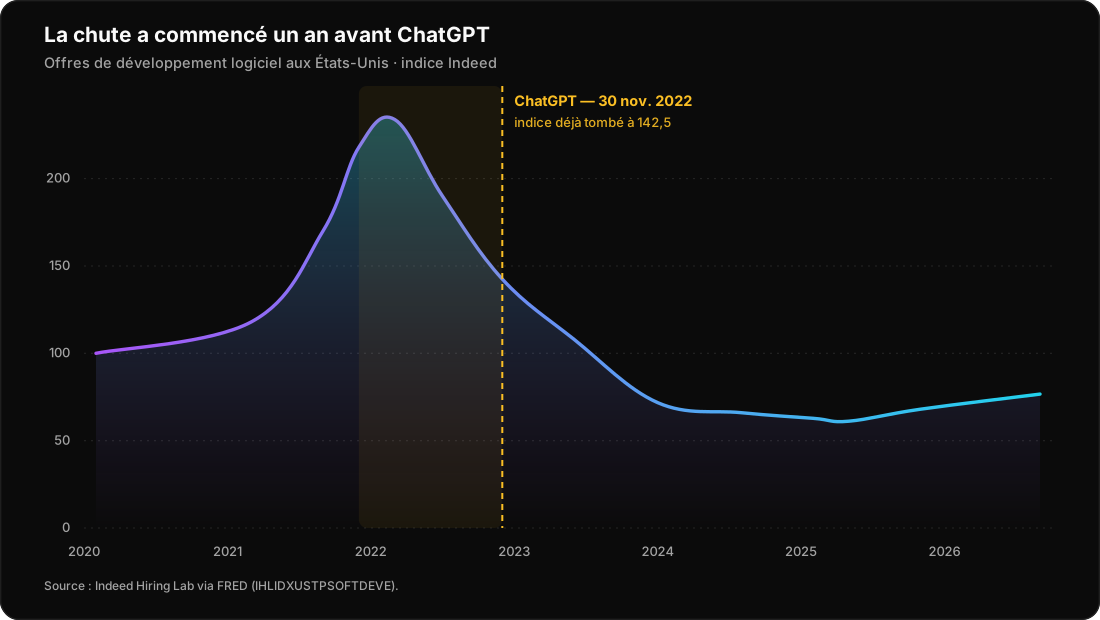
I started from a hunch shared by just about every developer I meet: AI arrived at the end of 2022, the job market collapsed right after, and it is only now starting to recover because employers have worked out that you do not replace a developer with a language model. I added two personal convictions on top. That the United States was two or three years ahead of us, and that its curve therefore told us what was coming. And that a developer equipped with AI produces ten times more than before, because I see it in my own work.
Before writing about any of it, I wanted to open the actual data series rather than recycle impressions. Indeed Hiring Lab, the US Federal Reserve, Stanford, APEC, the controlled trials on productivity. I was wrong on all three points. And not by a little: on the timeline I was off by more than a year, and on the “10×” I was conflating two different quantities. Here is what the numbers actually say.
The fall started a year before ChatGPT
This is the correction that surprised me most, because it can be verified to the week. The Indeed index of software development postings in the United States peaks at 217.96 on 20 December 2021. ChatGPT launches on 30 November 2022. On that day, the index has already fallen to 142.50. It would eventually bottom out at 62.79 in February 2025.
In other words: 35% of the total destruction of demand happened during a period when the tool being blamed did not exist publicly. You cannot pin on ChatGPT a fall of which a third was already spent before it shipped.

The cause identified by economists is monetary, not technological. Postings for the roles most exposed to AI peaked in the spring of 2022, and their decline was already six months old when ChatGPT arrived. The correlation with the Fed's policy rate is described as “extremely strong”, with the downturn starting exactly when the central bank started raising rates. There is nothing mysterious about the mechanism: AI-exposed roles are concentrated in tech, finance and services — precisely the sectors most sensitive to the cost of money.
Stanford, reviewing the literature, concludes that hiring declines began “after the Fed's monetary policy shift but before the debut of ChatGPT”. Add to that the correction of post-Covid over-hiring, the shift to remote work that pushed employers towards experienced profiles, and an American tax factor little known in France: Section 174, which since 2022 has forced companies to amortise their R&D costs over five years instead of deducting them in the same year. Engineering salaries became more expensive in tax terms at the precise moment venture capital was drying up.
Since 2022, unemployment among workers highly exposed to AI has risen by 0.77 points. Among the least exposed workers, by 0.85 points. The least exposed group fared slightly worse — if AI were the main driver, that sign would be reversed.
That does not mean AI has no effect: the opposite position is just as wrong. The reading that holds up has two phases. From 2022 to 2024, a macroeconomic shock. From 2024, the macro tailwinds fade while substitution by AI becomes measurable — and it is, specifically at the entry level. The AI effect is real. It simply arrived later than the story claims, and on a market that was already flat on its back.
The recovery exists, but it does not look like a recovery
US postings are up almost 15% since February 2025, while the job market as a whole fell by 7%. Tech is outperforming. Except the composition of that rise is unambiguous: 71% comes from senior roles, and 37% from roles mentioning AI in the title. In the first quarter of 2026, senior roles account for 69.3% of development postings, entry-level roles 4.5%.
Meanwhile, layoffs are setting records: 128,536 people as of 10 September 2026, already more than the whole of 2025. Postings rising and layoffs rising at the same time is not a recovery. It is a reallocation. The same company cuts and hires, but not the same profiles.
One last figure to calibrate the optimism: at 76.62 in September 2026, the US index remains around 23% below its February 2020 level. Before the bubble. The “recovery” is a climb back towards a level that is still depressed.
The American lead: 4 months on the fall, 16 months on the recovery
I believed the gap was two or three years. I calculated the peaks and troughs country by country. On the fall, there is barely any lead at all: the United States peaks in February 2022, France in July 2022. Four and a half months. Nothing resembling a strategic head start.
| Country | Peak | Trough | Sept. 2026 | Since the trough |
|---|---|---|---|---|
| United States | 233.8 — Feb. 2022 | 61.1 — May 2025 | 76.6 | +25.4% |
| United Kingdom | 181.5 — Apr. 2022 | 53.4 — Apr. 2025 | 62.1 | +16.4% |
| France | 141.0 — Jul. 2022 | 49.9 — Jul. 2026 | 53.0 | +6.2% (unconfirmed) |
| Germany | 169.0 — May 2022 | 49.2 = latest reading | 49.2 | still falling |
It is on the recovery that the gap is real, and it is huge: the United States hit bottom in May 2025, France has its low point in July 2026 and is only 6.2% above it — within the noise of a flat bottom. Germany has not hit its bottom at all yet. Sixteen months of gap at the very least, and the story is not over.
But the country that breaks my theory is European. The United Kingdom hit its low point six weeks before the United States, and has climbed back 16.4%. So the fault line in the data is not the Atlantic.

Indeed Hiring Lab offers an explanation that inverts my hunch: English-speaking countries would be earlier adopters of agentic AI tooling, and it is that adoption pulling their recovery along. If that is true, the French lag is not the delayed echo of the 2022 rate shock — it is a lag in AI adoption that turns into a lag in hiring. The available data does not allow a verdict between the two theories, and that has to be said rather than picking whichever one is convenient.
One thing is certain, though: the French constraint is not developer tooling. Individual AI use by developers is close to universal everywhere — 84% according to Stack Overflow 2025, 85% according to JetBrains. What differs is the digital maturity of the clients.
The French case, without the sugar coating
The French numbers are not good and I would rather give them as they are. Hiring of IT managerial staff is down 21% compared with 2023 according to APEC. Companies that are members of Numeum hired 83,000 people in 2023, 51,000 in 2025. Turnover is at an all-time low of 15.6%, which reflects less a retention success than a market where nobody moves any more.
The most actionable detail for an independent is elsewhere: the share of nearshore and offshore in the revenue of French IT services firms went from 15.5% to 18% in twelve months. The consequence is direct — revenue growth at those firms in 2026 does not imply a recovery in developer hiring in France, because the marginal capacity is bought elsewhere. We will see revenue recover before postings do.
While we are here, a correction: the “−80% of dev postings in France” figure going round the French tech press corresponds to nothing in the index. The real drop is 62.4% since the peak. That is already plenty severe enough without needing to be exaggerated.
No study has ever found the “10×” — and yet I live it every day
Now to my most solid conviction, the one I thought was beyond dispute because I observe it in my own work. No controlled study, vendor or independent, has ever measured anything close to a 10× gain for developers. The highest credible figure is +55.8% on a toy task on greenfield code. Even the vendors selling these tools publish between 20 and 55%.

The most uncomfortable result comes from METR, in July 2025: sixteen experienced open-source developers, 246 real tasks on their own repositories. Measured result, stopwatch in hand: 19% slower with AI. They had expected to be 24% faster. After the experiment, and after being slowed down, they still believed they had gained 20%.
Forty points of gap between the felt and the measured, among professionals working on their own code. This result does not say that those who feel faster are wrong. It says something more awkward: none of us can settle this question by observing ourselves. That is exactly why we run controlled trials.
Then there is the argument that depends on no study at all and settles the question by arithmetic. Writing code accounts for 20 to 30% of a developer's work — nearly 80% of us now spend less than half our week coding. Even a ×10 accelerator applied to that portion alone caps the total gain at about 1.22×. That is Amdahl's law. Claiming a global 10× is implicitly claiming that AI has also multiplied scoping meetings, code review and debugging by ten.
Why my 10× and the studies' 1.2× are both true at once
I nearly stopped there and concluded I was kidding myself. Then I looked at what those studies measure exactly, and the contradiction dissolved. The two camps are not measuring the same quantity.
On a task I know how to specify, in a codebase I know, where the job is to produce code I could have written myself — a CRUD, a migration script, a test suite, an admin back office — the factor of 10 against typing by hand is real. It is even consistent with the studies: that is exactly the category where +55.8% and 35 to 40% get measured, and on 2023-2025 tooling at that.
What my experience structurally cannot see comes down to three mechanisms. The first is the denominator: the studies do not measure coding, they measure delivery. DX counts merged pull requests across more than 400 companies. Between my generated code and a merged PR there is review, QA, security, integration. I feel the acceleration on the portion I execute; the organisation measures what comes out of the pipe.
The second is memory selection. The gain is largest on simple tasks and drops to 10% or less on complex legacy. And the spectacular moments, the ones we remember and retell, mechanically cluster in the first category. The three hours lost debugging a subtly wrong generation in an old module produce no anecdote — they look like an ordinary working day.
The third is METR's perception gap, which targets introspection itself and applies just as much to someone who believes they are ten times faster as to someone who believes they are being slowed down.
But lived experience deserves its best argument, and it is a serious one: there is no randomised controlled trial on 2026 agentic tooling. METR was testing completion assistants from early 2025. The reference study on Copilot dates from 2022. When a developer describes a 10× today, they are often describing a class of tools the published literature has not yet evaluated. It is the gap most exploited by marketing talk — and it is also the best reason to think the published figures underestimate the reality of 2026.
Two things still prevent concluding that the organisational 10× arrived without anyone noticing. First, the DX series runs through February 2026 with AI usage up 65% over the period, and still finds 5 to 15%: if agentic tooling had multiplied throughput by ten, that series would have seen it. Second, the downstream friction is getting worse rather than easing. AI-generated code waits 4.6 times longer for its first review. Block duplication is up 81%, reaching its record level. And 2024 was the first year copy-pasting overtook refactoring.
The 10× is real at the level of the generation task. It does not propagate to the team level, because the bottleneck has moved from writing to verifying. Both statements are true at the same time, and it is the gap between them that shows where a developer's value now sits.
Anyone citing the 10× to justify shrinking an engineering team is making an arithmetic error. Anyone citing the 1.2× to deny the tool's usefulness is ignoring that the literature has not measured the generation of tools we are talking about.
Three hours on a button hover, or on an architected feature?
This is the question that drove the whole investigation, and it is the only one where my hunch was right. For a measured reason, not out of conviction.
Veracode tested 80 completion tasks with known security weaknesses across more than a hundred models. The assistants now exceed 95% functional correctness — the code works. But their pass rate on the security tests remains stuck around 55%, practically identical to two years earlier. The models have become much better at writing code that works, and not at all better at writing code that is safe.
| What AI does | Level reached | Progress in two years |
|---|---|---|
| Writing code that works | > 95% | strong |
| Writing secure code | ~ 55% | near zero |
| Block duplication introduced | +81% (record) | getting worse |
| Wait before first review | 4.6× longer | getting worse |
The two facts say the same thing from two angles: AI optimises for locally plausible code rather than globally coherent systems, and the cost is deferred. It does not show up in cycle time but in churn and in the change failure rate, which went from 5% to 6% after adoption.
The conclusion that follows is that AI has inverted the returns of the two halves of the job. Producing syntax has become almost free, so almost worthless as a differentiator. Judgement about correctness, safety and structure has become the limiting constraint, so the place where a developer's hours compound. The three hours on the hover effect buy a skill in the process of being commoditised. The three hours on the architected feature buy the one the market is bidding up.
That is also where the 10× finds its most profitable use. If generation really is ten times faster on the favourable subset, then the time freed up has one optimal destination and only one: pour it into the step that has become the limiting one. The same three-hour gain produces opposite outcomes depending on whether it funds ten generated and unreviewed features — which load the bottleneck and get paid for in debt — or one feature generated and then architected, tested and put through security scrutiny. The 10× is not a reason to ship ten times more code. It is a reason to be finally able to afford the work nobody had time for.
An honest caveat, because it matters: to date there is no salary or postings data showing that architecture, debugging or security specifically command a growing premium. The mechanism is established, the salary consequence is not yet measured. And there is a learning guardrail — the ability to assess an AI's output is built by having written things by hand. For a beginner, the hover effect has an educational value it no longer has for a professional. The right answer depends on whether the three hours are for learning or for shipping.
Which jobs are actually under threat
The measured answer is more precise than “developers” or “nobody”. What collapsed is not the stock of developer jobs, it is the on-ramp. Employment among 22-25 year olds in AI-exposed roles is running about 19% behind its expected trend, and young developers specifically are down about 20% since the end of 2022. Among 41-49 year olds, in the same companies, no divergence by AI exposure. The mechanism is not layoffs, it is hiring stopping.
Meanwhile, US tech unemployment is at 2.9%, below the national rate of 4.2%. The 2026 problem is therefore better described as an entry problem than as an unemployment problem for those already in post.
The most reliable predictor I found for which way a job falls is the distinction between automative and augmentative use: jobs where AI does the task instead of the human lose employment, jobs where it assists the human gain it. The most telling historical precedent is not cash machines but accounting: bookkeepers are down 5% while accountants are up 6%. Same field, opposite directions. Translators today occupy the bookkeeper's position — the IMF went from 200 to 50 in-house translators.
And we have to be honest about the other side: the catastrophist predictions of 2023 have not materialised at the scale of the economy. Goldman Sachs publishes that the correlation between AI adoption and employment outcomes is “weak and statistically insignificant”. Gartner measured that only one customer service leader in five had actually cut headcount because of AI, and expects half the roles eliminated in the name of AI to be rehired by 2027 under other titles. The dominant narrative overshoots the data in both directions.
For a freelancer: the market is splitting in two
This is the part that concerns me most directly, and the data is clear. Upwork publishes a statistic that sums it all up: generic execution contracts around generative AI have seen their volume rise by 90%, and their pay per contract fall by 13%. Over the same period, AI-augmented professional services are up 72% in volume and 22% in revenue per contract. Freelancers positioned on complex work earn 45% more.
More work, worse paid on one side. More work, better paid on the other. Fiverr, the platform most oriented towards standardised delivery, went from 4.1 to 2.7 million buyers since 2023, with marketplace revenue down 15.5% in the second quarter of 2026.
| Positioning | Observed rate | Trend |
|---|---|---|
| Generic web development | $45–75/h | deflating |
| AI agent development | $180–300/h | rising premium |
| Junior day rate, France | €420/day | low and flat |
| Median day rate, France | €580/day | flat |
| AI / ML day rate, France | €1,050/day | +54% since 2020 |
The dominant mechanism is not job cuts, it is the deflation in the price of undifferentiated execution. Three unrelated markets show the same signature: Indian IT services openly talk about “AI deflation” with revenue expected to fall 3 to 5%, Upwork's generic gigs lose 13% of unit value, and the nearshore rate-card model is declared obsolete. Volume goes up, unit price goes down.
A freelancer selling hours of execution is exposed to this mechanism even if nobody ever lays them off. The answer that comes out of three independent sources is the same: move from selling execution capacity to selling accountability for an outcome.
Should you rush into AI? Not exactly
I expected to conclude that yes, obviously, you have to get on board. The data says something more nuanced. Between 84 and 90% of developers already use AI. A behaviour shared by nine professionals out of ten is not a competitive advantage, it is a prerequisite. Adopting AI no longer differentiates anyone.
More interesting: no study measures any penalty for developers who do not adopt AI. What does exist is a premium associated with AI skills in compensation data — which is not the same thing — and employer expectations that create a risk at the hiring-filter stage. The “adopt or die” thesis is an assertion, not a measurement. I say so while I would have preferred the opposite, because it sells better.
On the size of that premium, the sources contradict each other: Lightcast measures +28% across a billion postings, PwC measures 62%, Upwork about 34% more per hour. The gap is not a contradiction but a difference of method — Lightcast counts mentions in job ads, which conflates AI with seniority; PwC compares similar workers. None of the three is an estimate of what learning AI would do to your salary.
The detail that explains everything: AI skills appear in only about 2.5% of US postings, and within front-end roles they cluster in senior and staff positions (16 to 18%) against 0.7% at entry level. The premium therefore rewards a rare, architectural signal, not tool literacy. It is not “know how to use Copilot”, it is “know how to design a system that integrates AI”.
What I take away
Will AI replace jobs or transform them? On the data available in September 2026: it transforms many, it threatens a few through price rather than through replacement, and for developers it has mostly removed the first rung of the ladder without touching the rest. The most serious long-term projection, the World Economic Forum's in its 2025 report, puts 170 million jobs created against 92 million displaced by 2030 — a positive balance, but with this warning from the WEF itself: those who lose their jobs are not necessarily the ones who will hold the new ones.
For a developer in post, the risk in 2026 is not replacement. It is the deflation in the price of undifferentiated execution, and the fact that the job is moving simultaneously upstream — specification, architecture, threat modelling — and downstream — review, verification, integration — while the middle gets automated. That is exactly the opposite of the “we will do without developers” thesis.
For a beginner, the truth has to be told: the entry door has closed and the French recovery, as forecast, skips the juniors. APEC expects +4% managerial hiring in 2026, but only +1% for young managers.
And the only indicator that would deserve to worry me is none of the usual headlines. It is the measured migration, in API traffic, of coding usage from an augmentative mode towards an automated one. It is not yet employment data. It is the only leading signal in the whole body of evidence pointing in the direction historically associated with decline — and that is the one to watch, not the announcements.